


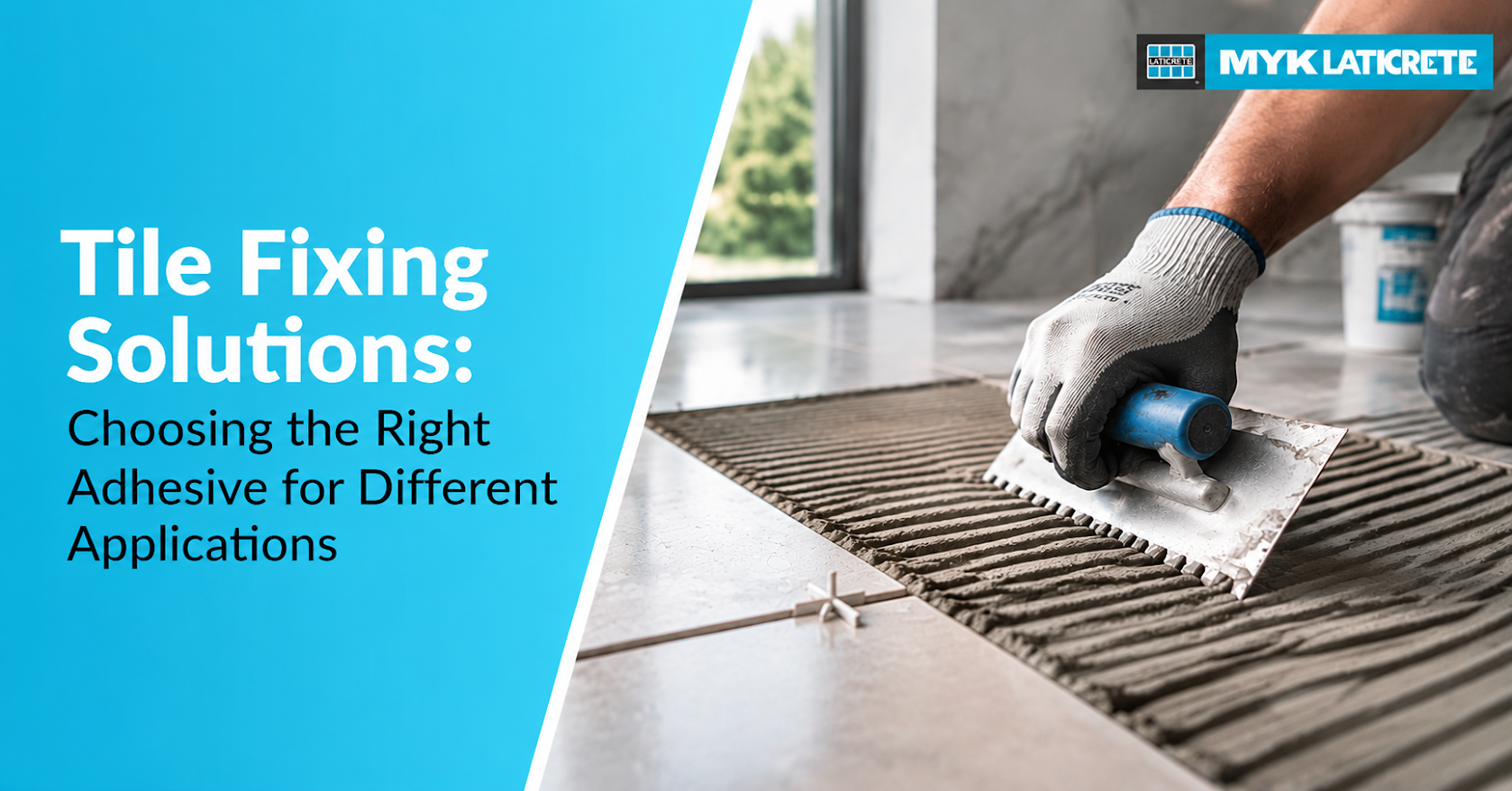
Colour, finish and design often guide tile selection. However, how well the tile performs over time depends largely on the adhesive and surface beneath it.
Using the wrong tile fixing adhesive can result in hollow spots, cracked joints, loose tiles and premature repairs. This has become a bigger concern as Indian projects increasingly use vitrified tiles, large-format slabs, natural stone and a wider range of installation surfaces.
There is no single adhesive that is suitable for every project. A product used for ceramic tiles on an internal floor may not be suitable for large-format tiles on an external wall. The correct choice depends on the tile material, tile size, substrate, installation area and expected site conditions.
Why the Right Tile Adhesive Matters
Cement mortar was widely used when tiles were generally smaller, more porous and installed over conventional cement-based surfaces. Modern tile installations are more demanding.
Projects today may involve:
- Low-porosity vitrified and porcelain tiles
- Large-format and slim tiles
- Natural or engineered stone
- Tile-on-tile renovation
- External walls exposed to heat and rain
- Bathrooms, swimming pools and other wet areas
- Drywall, plywood, metal and specialised substrates
Each application has different requirements. Factory-formulated tile adhesives are designed to provide consistent composition and performance for specific conditions.
Choosing the best adhesive for tiles is not simply about buying the strongest product available. The adhesive must suit the tile, the substrate and the area where it will be used.
Five Factors to Consider When Choosing a Tile Fixing Adhesive
1. Tile or stone material
Different materials behave differently during installation.
Ceramic tiles are generally more porous than vitrified and porcelain tiles. Vitrified and porcelain tiles absorb very little water, so they need an adhesive that can develop a reliable bond with their low-porosity surface.
Natural stone brings other factors into the selection process, including:
- Weight
- Porosity
- Moisture sensitivity
- Possibility of staining
- Dimensional stability
Engineered stone, agglomerates and quartz may require specialised adhesives. A conventional cement-based product may not be suitable for these materials.
The exact tile or stone material should always be identified before an adhesive is selected.
2. Tile size and weight
As tiles become larger and heavier, achieving adequate adhesive contact becomes more difficult.
Large-format tiles place greater demands on the adhesive and the substrate. Any voids beneath the tile can create weak areas and increase the risk of cracking or debonding.
Large and heavy tiles may require an adhesive with:
- Higher bond strength
- Greater flexibility
- Extended open time
- Better slip resistance for wall applications
- Suitability for the required bed thickness
Correct installation also becomes more important. The right trowel and application technique must be used to achieve the recommended adhesive coverage.
3. Installation area
The same tile can require a different adhesive depending on where it is installed.
An internal residential floor usually faces relatively stable conditions. External walls and terraces are exposed to heat, rain and temperature changes. Bathrooms and swimming pools experience regular moisture exposure, while commercial floors may face continuous foot traffic and rolling loads.
Before selecting an adhesive, confirm whether the installation is:
- Internal or external
- On a floor or wall
- In a dry or wet area
- At ground level or at height
- In a residential or high-traffic commercial space
These conditions help determine the performance level required from the adhesive.
4. Substrate type and condition
The substrate is the surface to which the tile will be fixed. Even a high-quality adhesive may fail if the substrate is weak, dusty, uneven or incompatible with the product.
Common substrates include:
- Concrete
- Cement plaster
- Cement mortar beds
- Existing tiles
- Cement boards
- Gypsum boards
- Plywood
- Metal
The surface should be sound, stable and free from dust, grease, paint, loose particles and other materials that may affect adhesion.
Tile-on-tile installations need additional checks. Existing tiles must be firmly bonded and free from hollow areas. The surface must also be prepared according to the adhesive manufacturer’s instructions.
Surfaces such as plywood, metal and drywall may need a specialised polyurethane, epoxy or hybrid adhesive.
5. Movement and exposure
Tiles, substrates and structures respond differently to temperature, moisture and loading.
Balconies, terraces and external walls expand and contract as temperatures change. Commercial and infrastructure projects may also experience vibration, heavy loads or continuous traffic.
Adhesives used in these areas need enough flexibility to handle the expected movement. Tile spacing and movement joints must also be planned correctly. A flexible adhesive cannot make up for missing joints or poor installation practices.
Choosing Tile Adhesive for Different Applications
Internal ceramic tile installations
Small ceramic tiles installed on sound cement-based internal surfaces are generally less demanding than large-format, exterior or specialised installations.
For these areas, the adhesive should provide:
- Reliable bonding
- Good workability
- Adequate open time
- Suitability for the floor or wall surface
The tile dimensions, wall height and substrate should still be checked before selecting a product.
Vitrified and porcelain tiles
Vitrified and porcelain tiles have low water absorption. This makes polymer-modified adhesives a more suitable choice than conventional cement mortar.
For suitable internal floor and wall applications, LATICRETE® 315 Plus can be used for ceramic and vitrified tiles within the tile size and installation limits stated in its technical guidance.
It is a Type 2T adhesive under IS 15477:2019 and is classified as C2TE under EN 12004 and ISO 13007.
Larger tiles, greater wall heights and demanding site conditions may require a higher-performance product. The current technical data sheet should be checked before application.
Large-format tiles and slabs
Large-format tiles require careful planning because their size makes substrate flatness and adhesive coverage more important.
A suitable large-format tile adhesive may need to provide greater flexibility, longer working time and higher bond strength. The final choice depends on:
- Tile material
- Tile dimensions and weight
- Floor or wall application
- Installation height
- Internal or external exposure
- Type of substrate
MYK LATICRETE offers high-performance products for large-format applications within its tile adhesive range.
Back-buttering may be required to achieve proper coverage, particularly for large-format, heavy or externally installed tiles. The product instructions should be followed for the recommended trowel size, bed thickness and application method.
Tile-on-tile renovation
Tile-on-tile installation can reduce demolition, dust and project time. However, it should only be considered after checking the condition of the existing tiled surface.
Before beginning, check for:
- Loose or hollow tiles
- Cracks in the existing surface
- Grease, coatings or contamination
- Uneven areas
- Signs of moisture or leakage
- The ability of the surface to carry the additional load
Damaged or poorly bonded tiles must be removed or repaired first.
Where the existing tiled floor is stable and properly prepared, LATICRETE® 315 Plus may be considered for suitable tile-on-tile applications within its stated limits.
Covering an unsound installation with new tiles will only hide the problem temporarily.
Bathrooms and wet areas
Bathrooms and showers need more than a moisture-resistant adhesive. They require a properly planned waterproofing and tile installation system.
The waterproofing membrane prevents water from entering the structure. The adhesive secures the tiles above it. Grout and sealants protect the joints and complete the tiled finish.
A typical wet-area system includes:
- A stable and prepared substrate
- An application-suitable waterproofing membrane
- A compatible tile adhesive
- Correct tile and movement joints
- Suitable cementitious or epoxy grout
- Sealant at corners and movement points
Explore MYK LATICRETE waterproofing solutions when planning bathroom, shower or other wet-area installations.
The adhesive should then be selected according to the tile material, tile size, substrate and whether the surface is a floor or wall.
Balconies, terraces and external walls
External tiled surfaces face regular exposure to heat, rain and temperature changes. These conditions create movement within the tile assembly.
A flexible, polymer-modified adhesive is generally required for these applications.
LATICRETE® 325 High Flex is a Type 3, C2TE high-polymer-modified adhesive designed for internal and external floor and wall installations within its specified limits.
It can be used for suitable ceramic, vitrified, glass mosaic and natural stone applications. The product is also designed for wet areas such as washrooms and swimming pools.
High-rise façades, very large tiles and installations above the specified height may require a more advanced adhesive system and a project-specific technical assessment.
Natural stone
Natural stone varies greatly from one type to another. Marble, granite and other stones can differ in weight, porosity, colour and sensitivity to moisture.
Before choosing a stone adhesive, consider:
- Type and thickness of stone
- Size and weight
- Possibility of staining
- Internal or external application
- Floor or wall installation
- Installation height
- Substrate type
White adhesive may be preferred for light-coloured or translucent stone where the adhesive colour could affect the final appearance.
MYK LATICRETE offers dedicated stone adhesive solutions for different natural stone applications.
Engineered stone and specialised substrates
Engineered stone, agglomerates and quartz may not be suitable for installation with conventional cement-based adhesives.
Metal, plywood, drywall and other specialised surfaces also need careful product selection. These applications may require polyurethane, epoxy or hybrid adhesives.
Products such as PUA 212® are designed for specialised tile and stone installations across a range of materials and surfaces. The appropriate product must be confirmed based on the material, substrate and application.
Explore the MYK LATICRETE specialty adhesive range for these requirements.
Quick Tile Adhesive Selection Guide
| Application | Main factor to consider | Suitable adhesive direction |
|---|---|---|
| Small ceramic tiles in dry internal areas | Compatibility with the cement-based substrate | Standard application-suitable tile adhesive |
| Vitrified and porcelain tiles | Low water absorption | Polymer-modified adhesive |
| Large-format tiles | Tile size, weight, coverage and movement | High-performance flexible adhesive |
| Tile-on-tile installation | Condition of the existing tiled surface | Approved tile-on-tile adhesive |
| Bathrooms and showers | Waterproofing and product compatibility | Waterproofing system with a suitable adhesive and grout |
| Balconies and terraces | Thermal movement and weather exposure | Flexible polymer-modified adhesive |
| External walls | Height, tile weight and thermal stress | High-performance flexible adhesive |
| Natural stone | Weight, moisture sensitivity and staining | Stone-compatible adhesive |
| Engineered stone, metal or plywood | Material and substrate compatibility | Specialised PU, epoxy or hybrid adhesive |
| Commercial areas | Traffic, loading and service conditions | Project-specific high-performance system |
This table should be used as an initial guide. The final product selection must be based on the site conditions and the latest product technical data sheet.
Common Mistakes That Can Cause Tile Failure
Selecting the correct adhesive is only one part of a successful installation. Poor surface preparation or application can still lead to failure.
Common mistakes include:
- Applying adhesive over a dusty or weak surface
- Ignoring cracks or hollow areas in the substrate
- Adding too much water during mixing
- Using adhesive after it has formed a skin
- Applying adhesive in isolated spots
- Using the wrong notched trowel
- Leaving inadequate adhesive coverage beneath the tile
- Installing tiles without the required joint spacing
- Ignoring movement joints
- Using adhesive to correct excessive surface unevenness
Installers should follow the manufacturer’s instructions for mixing, open time, bed thickness, coverage and curing.
Large-format, external, wet-area and high-rise installations should be handled by trained applicators with suitable technical guidance.
Why a Complete Tile Installation System Performs Better
Adhesive is only one layer of a tiled surface. Long-term performance depends on how all the layers work together.
Depending on the application, a complete installation may include:
- Surface preparation products
- Waterproofing membrane
- Tile or stone adhesive
- Movement and perimeter joints
- Cementitious or epoxy grout
- Sealants
- Cleaning and maintenance products
Using compatible products reduces the possibility of one layer affecting the performance of another.
MYK LATICRETE provides tile adhesives, tile joint and grout solutions, waterproofing products, stone adhesives and specialty adhesives for residential, commercial and infrastructure projects.
How MYK LATICRETE Helps With Product Selection
A reliable tile adhesive brand should help users choose a product based on the application, instead of expecting one product to solve every fixing requirement.
MYK LATICRETE supports architects, contractors, applicators and homeowners through:
- Application-specific tile and stone installation systems
- Products classified according to relevant standards
- Technical data sheets and specification resources
- Product selection and coverage tools
- Installation guidance and applicator training
- Solutions for residential, commercial and infrastructure projects
Users can enter their tile, substrate and application details into the MYK LATICRETE Product Recommender to identify suitable options.
Conclusion
Choosing a tile fixing adhesive requires a clear understanding of the application.
Start by answering five questions:
- What tile or stone is being installed?
- What are its size and weight?
- Where will it be installed?
- What is the substrate?
- What moisture, movement or loading will it face?
These details make it easier to identify the correct adhesive and supporting installation products.
MYK LATICRETE offers tile adhesives, waterproofing, grouting, stone installation and specialty solutions for different materials, substrates and project conditions. Selecting the right combination at the beginning can reduce installation problems and help the tiled surface perform reliably over time.
FAQs
1. Which tile adhesive is best for vitrified tiles?
Vitrified tiles generally require a polymer-modified adhesive suitable for low-porosity materials. Tile size, substrate, application area and wall height must also be considered before selecting a product.
2. Can the same tile adhesive be used for every application?
No. Internal floors, wet areas, external walls, large-format tiles, natural stone and specialised substrates have different requirements. The adhesive should be selected for the specific application.
3. Can tile adhesive be applied over existing tiles?
Yes, if the product is approved for tile-on-tile use and the existing tiles are firmly bonded. The surface must be clean and prepared according to the adhesive manufacturer’s instructions.
4. Is tile adhesive waterproof?
Tile adhesive secures the tile but does not replace a waterproofing membrane. Bathrooms, showers, balconies and other moisture-prone areas should have a suitable waterproofing system beneath the tiles.
5. How much tile adhesive is required per square foot?
Consumption depends on the tile size, substrate flatness, trowel size, bed thickness and application method. The MYK LATICRETE Adhesive Coverage Calculator can provide an estimate. Actual consumption may vary depending on site conditions.




